

How America Outsourced Thinking—Part 1: FDR and the Birth of Intimate Politics
Part 1 of a 4-episode series.

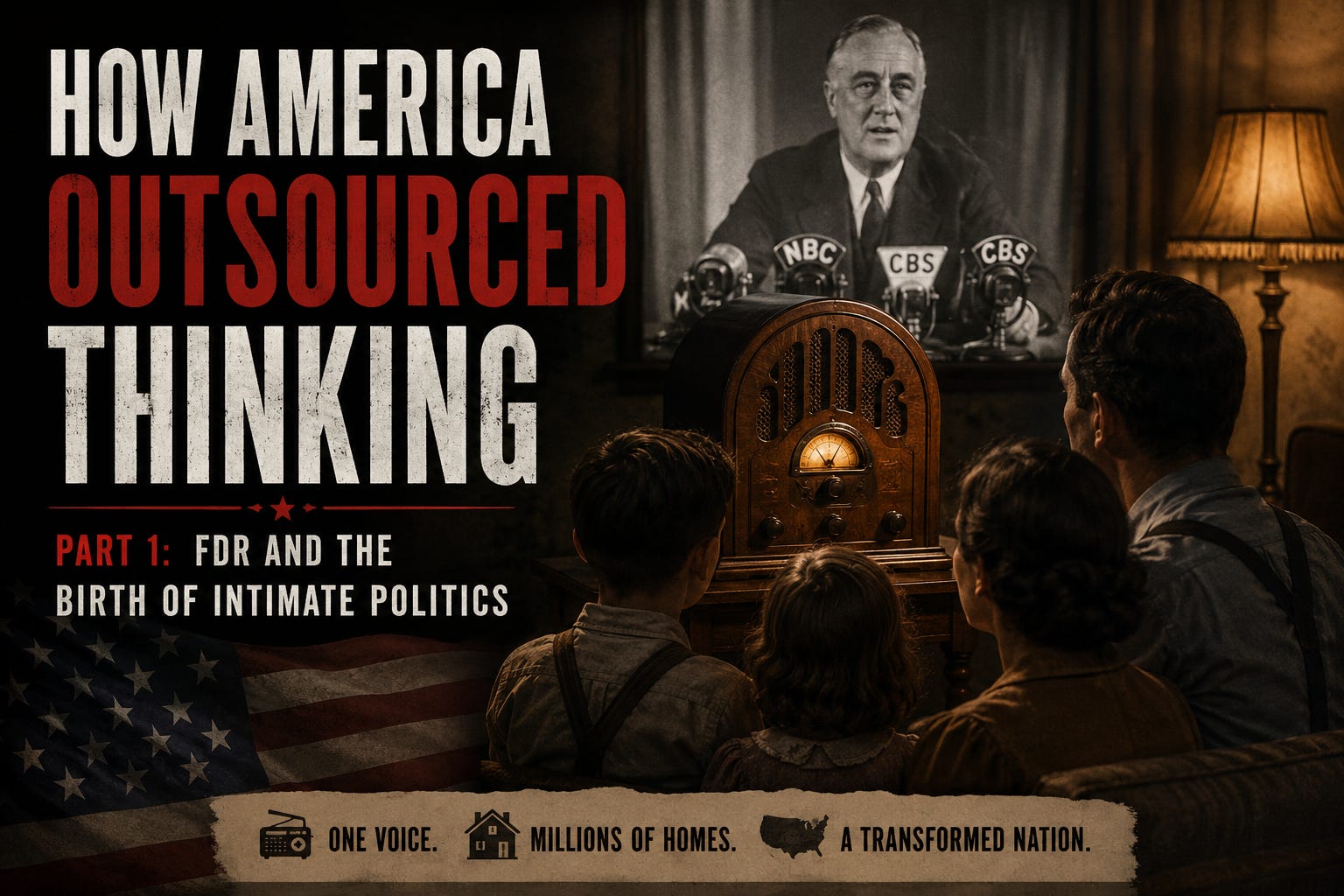
Imagine coming home from work, sitting down to dinner with your family, and then gathering around the radio as the President of the United States speaks directly to you about how he is guiding the nation through the Great Depression. This was everyday life for millions of Americans during Franklin D. Roosevelt’s 12-year presidency.
The radio addresses became known as the Fireside Chats. FDR began them just eight days after his 1933 inauguration, using the first one to explain the Emergency Banking Act to a nervous nation. He had actually pioneered the format earlier as governor of New York, with his first known address dating back to 1929.
To understand how innovative this was, consider the numbers. In 1930, only about 40% of American households had a radio. By 1940, that figure had climbed to 83%. The radio was the smartphone of its era—rapidly adopted and utterly transformative. Today, political candidates reach us through text messages, push notifications, and algorithmically targeted ads that land in our pockets. In the 1930s, FDR entered your living room instead. Different technology. Same intimacy.
Yet FDR understood something many modern politicians do not: less is more. Across a presidency that spanned the Great Depression, the rise of Nazi Germany, Pearl Harbor, D-Day, and nearly the entirety of World War II, he delivered approximately 30 Fireside Chats. He knew that scarcity preserves influence. Oversaturation weakens authority.
This restraint helped create one of the great paradoxes of his power. Millions of Americans knew FDR intimately as a calm, commanding voice of authority—yet in person he required a wheelchair. Mass communication allowed him to separate presidential presence from physical reality.
Contrast that with Abraham Lincoln at Gettysburg in 1863. Roughly 15,000 people gathered in an open field with no microphones, no amplification, and no speakers. Lincoln had to project his voice across the crowd after Edward Everett had already spoken for two hours. He delivered fewer than 275 words in about two minutes. According to the National Park Service, many in the audience barely realized he had begun before he finished.
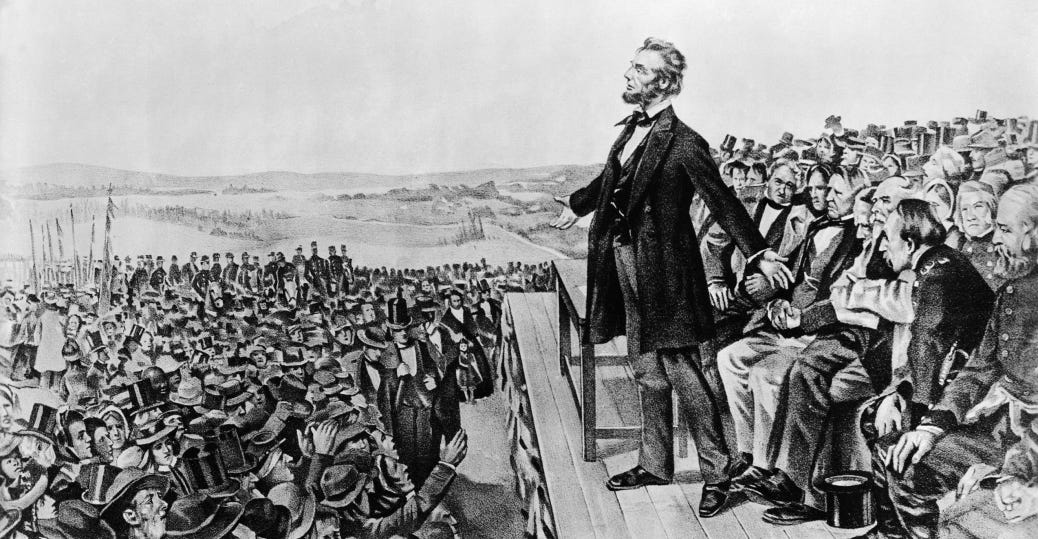
A sketch of Abraham Lincoln’s Gettysburg Address on November 18, 1863.
Before radio, the only way to hear spoken words simultaneously with someone else was to be physically in the same place. Radio shattered that limitation. For the first time, a family in San Francisco and a family in New York could hear the exact same presidential message at the exact same moment. America moved from a society where shared perspective depended on where you stood in the crowd to one where millions could experience the same mediated message together.
FDR leveraged this new power masterfully during global crisis. On September 3, 1939—just two days after Germany invaded Poland—he addressed the nation about the war in Europe. Two years later, he explained the Greer Incident, the first direct naval confrontation between American and German forces. Then came December 1941. Less than 48 hours after Pearl Harbor, his Fireside Chat became the emotional declaration of war.
His final chat came just six days after the Allied invasion of Normandy in June 1944. The war would outlast him. FDR’s health declined rapidly, and he died in April 1945, less than three months into his fourth term.
Radio’s political power did not die with him. On August 9, 1945, Harry Truman used the medium to speak to Americans about the Potsdam Conference and the atomic bombing of Hiroshima.
Radio remained dominant until television entered the chat. Its defining political moment arrived in 1960 with the first televised presidential debate between John F. Kennedy and Richard Nixon. Those who listened on radio generally thought Nixon had won. Those who watched on television overwhelmingly favored Kennedy. Same words. Different medium. Different verdict.
Media theorist Marshall McLuhan would later capture this truth in his famous line: “The medium is the message.”
FDR never had to face that test. He never participated in a presidential debate—on radio or otherwise. He never stood under bright lights, never sweated on camera, never allowed voters to visually compare him to an opponent. Radio let Americans feel they knew him intimately—without ever truly seeing him.
Had television arrived earlier, history might have looked very different. Because the voice that led America through depression and world war was delivered from a man who needed a wheelchair to get around.